What is an LLM Gateway?
Learn what an LLM Gateway is, why you need one, and how it simplifies integrating, managing, and deploying large language models in production.
By LLM Gateway
· Updated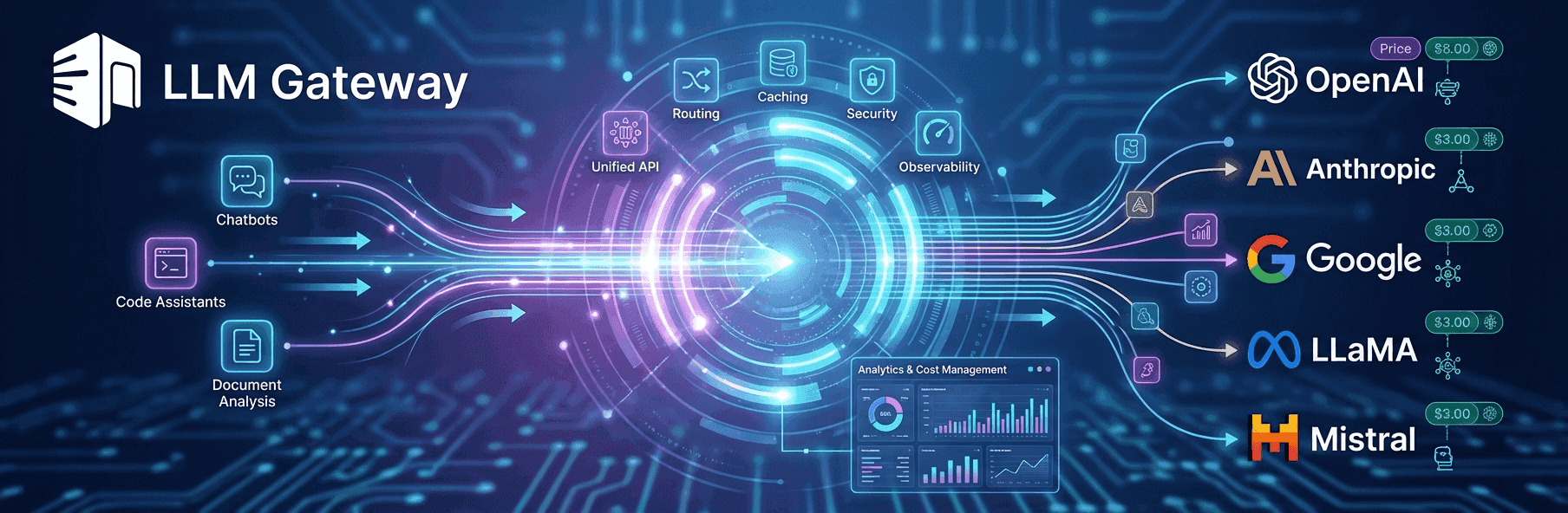
An LLM gateway is a middleware layer that sits between your application and LLM providers, exposing one unified, OpenAI-compatible API for many models. It handles request routing, failover, caching, cost tracking, and access control — so you can switch between OpenAI, Anthropic, Google, and open-weight models without changing your code.
Large language models power modern AI applications—from chatbots and code assistants to document analysis and automated customer support. But deploying LLMs at scale introduces challenges that most teams aren't prepared for.
Different providers have different APIs. Models have different capabilities and pricing. Requests need routing, caching, and monitoring. Security and compliance requirements add another layer of complexity. An LLM gateway solves these problems by acting as a centralized orchestration layer between your applications and the AI models they use.
Why LLMs Need a Gateway
Building production AI applications without a gateway means dealing with:
- Fragmented APIs: OpenAI, Anthropic, Google, and other providers all have different request formats, authentication methods, and response structures
- Model Selection Complexity: Choosing the right model for each use case requires understanding trade-offs between cost, latency, and capability
- Resource Management: Token limits, rate limiting, and concurrent request handling all need coordination
- Performance Monitoring: Understanding latency, error rates, and costs across providers requires custom instrumentation
- Security Concerns: API keys scattered across services, no audit trail, and no control over what data reaches external providers
- Scaling Demands: Handling traffic spikes, failovers, and load balancing across multiple providers
Each of these challenges is solvable individually—but solving them together, reliably, is where most teams struggle.
What an LLM Gateway Does
An LLM Gateway functions as middleware between your applications and AI providers. It intercepts every request, applies your policies, routes to the appropriate provider, and returns a standardized response.
Core Capabilities
Unified API Interface Instead of integrating with each provider separately, your applications talk to one API. The gateway handles translation, authentication, and provider-specific quirks behind the scenes.
Intelligent Request Routing Route requests based on model availability, cost, latency, or custom rules. Send complex reasoning tasks to Claude, simple queries to GPT-4o-mini, and embeddings to the cheapest available provider.
Automatic Failover When a provider experiences downtime or latency spikes, the gateway automatically routes to a backup. Your applications stay online even when individual providers don't.
Caching and Optimization Identical requests don't need to hit the provider twice. Semantic caching can serve similar requests from cache, reducing costs and latency by 80% or more for repeated queries.
Security and Access Control Centralized API key management means provider credentials never touch your application code. Role-based access control ensures teams only access approved models with appropriate spending limits.
Observability and Analytics Every request is logged with metadata: which user, which model, how many tokens, what latency, what cost. Debug issues, track spending, and optimize performance from a single dashboard.
One API key for every model.
Route to 200+ models with automatic failover, caching, and real-time cost analytics. Free to start — no credit card required.
How an LLM Gateway Works
A typical request flow looks like this:
- Request Handling: Your application sends a request to the gateway using a standard format (typically OpenAI-compatible)
- Validation: The gateway validates authentication, checks rate limits, and verifies the user has permission for the requested model
- Routing: Based on your configuration, the gateway selects the optimal provider and model for this request
- Transformation: The gateway translates the request into the provider's native format
- Execution: The request is sent to the AI provider, with automatic retry and failover if needed
- Response Processing: The response is normalized to a standard format and returned to your application
- Logging: Request metadata, tokens used, latency, and cost are recorded for analytics
Self-Hosting vs. Managed Gateways
LLM Gateways come in two flavors:
Managed gateways handle infrastructure for you. You get started in minutes with no servers to maintain. This works well for startups and teams that prioritize speed over control.
Self-hosted gateways run in your own infrastructure. Prompts containing sensitive data never leave your network. You control data retention, security policies, and compliance documentation. This matters for enterprises handling customer PII, financial data, or regulated industries.
LLM Gateway supports both approaches. Start with the managed service to move fast, then self-host when compliance or data residency requirements demand it.
The Cost of Not Having a Gateway
Teams without a gateway typically experience:
- Higher costs: No visibility into which teams or use cases drive spending, no caching, no cost-based routing
- Outages: Single provider dependencies mean their downtime is your downtime
- Security gaps: API keys in environment variables across services, no audit trail, no access control
- Slower iteration: Every new provider or model requires code changes across applications
A gateway doesn't just add features—it removes friction that slows down your AI development.
Getting Started
If you're building production AI applications, you need a gateway. The question is whether you build one yourself or use an existing solution.
Building your own seems straightforward at first: a simple proxy that forwards requests. But the edge cases multiply quickly. Rate limiting, streaming responses, function calling, image inputs, provider-specific errors—each adds complexity.
Most teams find that adopting an existing gateway pays for itself within weeks through reduced engineering time, lower AI costs, and fewer production incidents.
An LLM Gateway isn't just infrastructure—it's the foundation for scaling AI across your organization safely and efficiently.
Comparing your options? See how LLM Gateway stacks up against OpenRouter, LiteLLM, and Portkey, or browse the best AI gateways in 2026.
Ready to simplify your LLM infrastructure? Get started with LLM Gateway
One API key for every model.
Route to 200+ models with automatic failover, caching, and real-time cost analytics. Free to start — no credit card required.