Back to guides

Hermes Agent Integration

Use any model with Hermes Agent through LLM Gateway. One config change, full cost tracking, 210+ models.

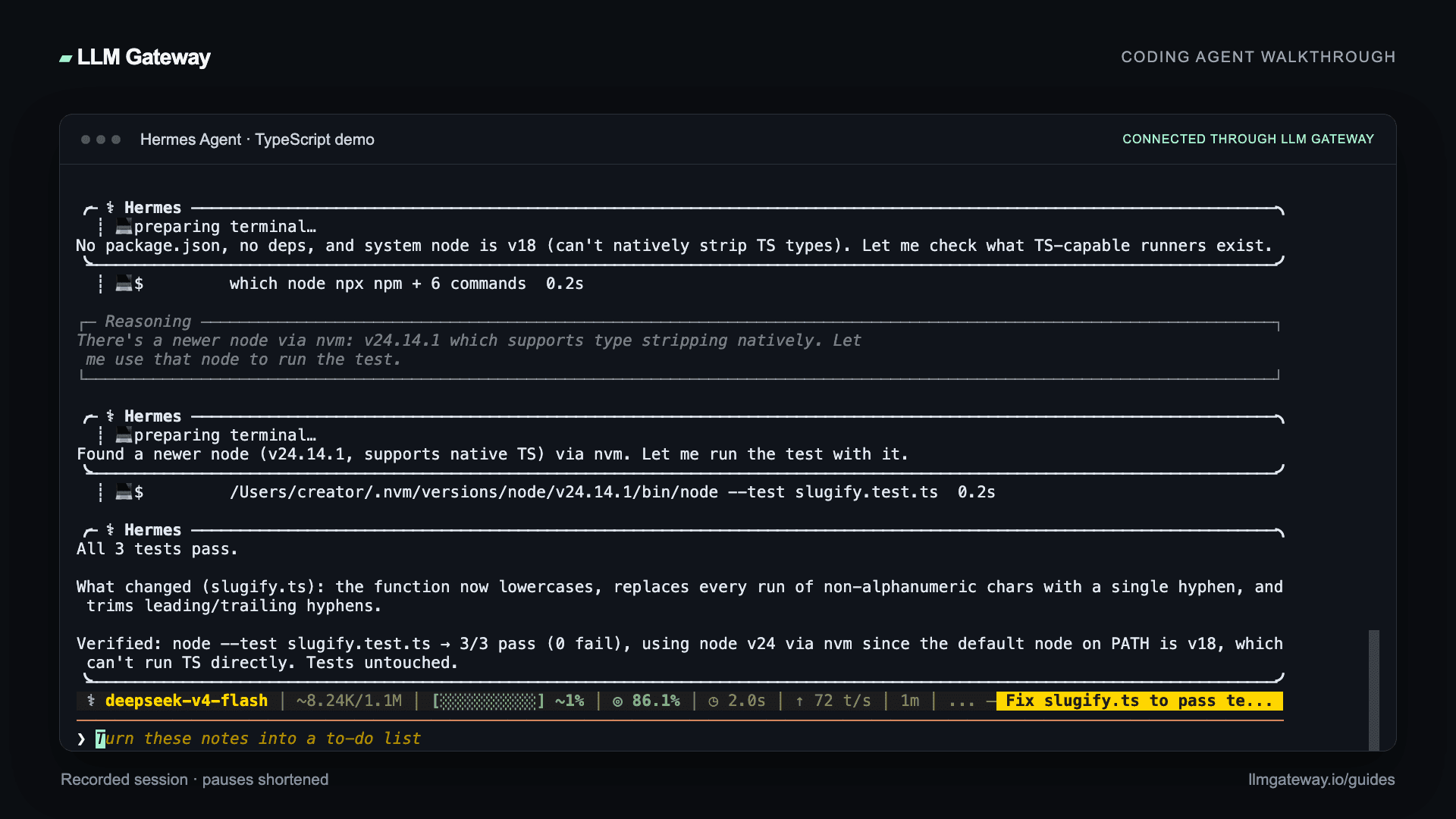
Hermes Agent is an open-source AI coding agent for your terminal built by Nous Research. It supports tool use, browser automation, multi-provider routing, skills, and MCP servers. By pointing it at LLM Gateway you get access to 210+ models from 60+ providers, all tracked in one dashboard.

One config change. No code changes. Full cost tracking.

Prerequisites

  • Hermes Agent installed — see installation below or visit the Hermes Agent repo
  • An LLM Gateway API key — sign up free (no credit card required)

Installation

Install Hermes Agent using the official install script:

1curl -fsSL https://raw.githubusercontent.com/NousResearch/hermes-agent/main/scripts/install.sh | bash

After installation, reload your shell and verify:

1source ~/.bashrc2hermes --version

The installer handles Python 3.11, Node.js, ripgrep, and other dependencies automatically. See the repo for Windows (PowerShell) and manual install options.

Setup

Step 1: Run the Setup Wizard

Run hermes setup to launch the interactive setup wizard. You can choose either Quick setup (option 1) for provider, model, and messaging configuration, or Full setup (option 2) to configure everything including tools, skills, and advanced options:

1hermes setup

Hermes Agent Setup Wizard

In this guide we use Quick setup, but Full setup works the same way — it just includes additional configuration steps.

Step 2: Configure Inference Provider

The wizard will ask you to configure your inference provider. Select Custom OpenAI-compatible endpoint and enter the LLM Gateway base URL:

1API base URL: https://api.llmgateway.io/v1

Then paste your LLM Gateway API key (starts with llmgtwy_):

Inference Provider Configuration

Step 3: Choose a Model

The wizard presents a list of 200+ available models. Type a model name or select from the list. Popular choices include claude-sonnet-4-6, gpt-5.5, or gemini-3.1-pro:

Model Selection List

Step 4: Set Context Length

Leave the context length blank to auto-detect (recommended), or specify a custom value:

Context Length Configuration

Step 5: Set Display Name

Give your provider configuration a display name. This appears in the Hermes status bar when chatting:

Display Name Configuration

Step 6: Select Terminal Backend

Choose your terminal backend. In this guide we use Local (run directly on this machine), but you can pick any option based on your requirements — Docker for isolated containers, SSH for remote machines, Modal for serverless sandboxes, Daytona for cloud dev environments, and more:

Terminal Backend Selection

Step 7: Setup Complete

Once done, Hermes shows you where your config files are stored and how to edit them. It will prompt "Launch hermes chat now? [Y/n]" — press Y to start an interactive agent session immediately:

Setup Complete

Your configuration files:

  • Settings: ~/.hermes/config.yaml
  • API Keys: ~/.hermes/.env
  • Data: ~/.hermes/cron/, sessions/, logs/

Once you press Y, Hermes launches a full agent session connected to LLM Gateway. You can start chatting right away.

Using Hermes with LLM Gateway

Once configured, all requests route through LLM Gateway. You'll see the provider name (e.g., "LLMGATEWAY") in the Hermes status bar.

Switching Models at Runtime

You can switch models mid-session using the /model slash command (similar to how Claude Code uses slash commands). Just type /model followed by the model name:

Switching to Claude Haiku via LLM Gateway

Switch to any model available through LLM Gateway — from Claude to GPT to open-source models — without leaving your session:

Switching to GPT-5.4-nano via LLM Gateway

Add --global to persist the model change across sessions.

CLI Model Override

You can also override the model from the command line:

1# Use a specific model for this session2hermes chat --model gpt-5.53
4# Use a powerful model for complex tasks5hermes chat --model claude-opus-4-6

Why Use LLM Gateway with Hermes Agent

  • 210+ models — Claude, GPT, Gemini, Llama, DeepSeek, and more
  • One API key — Stop managing separate keys for each provider
  • Cost tracking — See exactly what each session costs in your dashboard
  • Response caching — Repeated requests hit cache automatically
  • Automatic fallback — If a provider is down, requests route to an alternative
  • Volume discounts — Check discounted models for savings up to 90%

One-Shot Mode

For scripting or CI pipelines, use the -q flag for a one-shot prompt:

1hermes chat -q "Explain what this function does" -Q

The -Q flag enables quiet mode, suppressing the banner and spinner for clean output. For pure one-shot mode (no interactive session):

1hermes chat -z "Generate a README for this project"

Useful Hermes Commands

Command Purpose
hermes Start interactive chat (default)
hermes setup Run the setup wizard
hermes setup model Change model/provider
hermes chat -q "..." One-shot prompt
hermes model Choose provider and model interactively
hermes config edit Open config in your editor
hermes doctor Diagnose connection/config issues
hermes sessions Browse and manage past sessions
hermes --continue Resume most recent session
hermes update Update to latest version

Locking to a Specific Provider

By default, LLM Gateway automatically fails over to alternative providers if your chosen provider is experiencing downtime. To disable fallback and always route to one provider, add the header via Hermes's request configuration.

Disabling fallback means requests will fail if the chosen provider is down. See the routing docs for details.

Troubleshooting

Model not found

If you get a "model not supported" error, check that your model ID matches exactly what's listed on the models page. Model IDs are case-sensitive.

Connection timeout

Verify your base_url is set to https://api.llmgateway.io/v1 (note the /v1 at the end). You can also check the HERMES_API_TIMEOUT environment variable if you're hitting timeouts on long-running requests.

Authentication errors

Make sure your api_key starts with llmgtwy_ and is valid. Check your dashboard to confirm the key is active.

Diagnosing issues

Run hermes doctor to check your configuration, connectivity, and credentials:

1hermes doctor

Old config overrides

If you previously used a different provider (e.g., OpenRouter), make sure to update both provider and base_url fields. The provider must be set to "custom" for LLM Gateway. Also check ~/.hermes/.env for any leftover OPENROUTER_API_KEY or other provider keys that might take precedence.

Get Started

Ready to run Hermes Agent on any model? Sign up for LLM Gateway and grab your API key.

Questions? Check our docs or join Discord.