The Hidden Cost of LLM Vendor Lock-in
Why building directly against a single LLM provider's API is riskier than you think, and how a gateway layer protects your AI investment.
By LLM Gateway
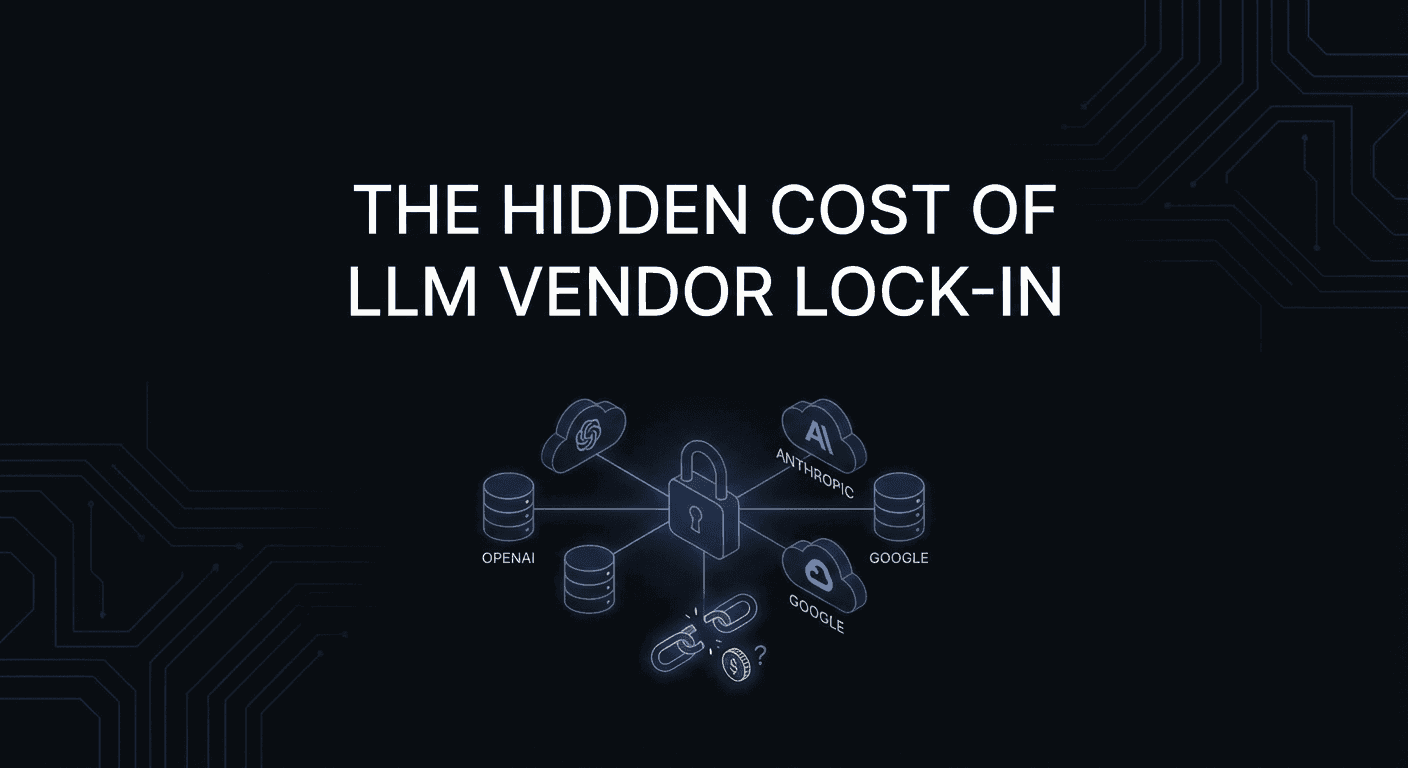
You've integrated OpenAI's API, your app is in production, and everything works. What could go wrong?
More than you'd think. Building directly against a single LLM provider creates risks that don't show up on your monthly invoice — but they can cost you far more than token fees when they materialize.
The Risks You're Not Pricing In
1. Pricing Changes You Can't Control
LLM providers adjust pricing regularly. Sometimes prices go down — great. But when they go up, or when a model you depend on gets deprecated in favor of a more expensive successor, you have two options: pay more, or rewrite your integration.
If your entire application is built against one provider's SDK, a pricing change affects 100% of your traffic. With a gateway, you can shift traffic to a cheaper alternative in minutes.
2. Model Deprecations
Providers regularly sunset models. When your model gets deprecated, you're on a deadline to migrate — testing a new model, validating outputs, updating prompts, and deploying changes. Under pressure. On someone else's timeline.
Recent examples:
- Claude 2.1 was deprecated in June 2025
- GPT-3.5 Turbo, once the default for millions of apps, has been superseded multiple times
- Google regularly cycles through Gemini preview versions with hard cutoff dates
Each deprecation forces work on your team that delivers zero new value to your users.
3. Outages and Rate Limits
Every major provider has had outages. OpenAI, Anthropic, Google — no one has 100% uptime. When your single provider goes down, your AI features go down with it.
Rate limits are the quieter version of the same problem. During peak traffic, you hit provider limits and requests start failing. Your users see errors. Your support queue fills up.
With multi-provider routing, an outage on one provider is a non-event. Traffic shifts to an alternative automatically.
4. Feature Lock-in
Each provider has its own SDK, its own request format, its own set of capabilities. The deeper you integrate, the harder it becomes to switch:
- OpenAI's function calling syntax differs from Anthropic's tool use
- Streaming implementations vary across providers
- Response formats, error codes, and rate limit headers are all different
- Caching, batching, and other optimizations are provider-specific
Every month you build deeper into one provider's ecosystem, the cost of switching grows.
What Lock-in Actually Costs
Let's put concrete numbers on it.
Migration cost: A mid-size team switching from OpenAI to Anthropic typically spends 2-4 weeks of engineering time on the migration. At $200K/year loaded cost for a senior engineer, that's $15K-$30K in engineering time — and zero new features shipped.
Outage cost: If your AI features generate $10K/day in value and your provider has 99.9% uptime (4.3 hours of downtime per year), you lose ~$1,800/year to outages. With 99.5% uptime (43 hours), that's $18,000/year.
Overpayment cost: If you're using a $10/M-token model for tasks that a $0.40/M-token model handles equally well, you're overpaying by 25x on those requests. For a typical app, that's thousands of dollars per month.
Put a compliance boundary in front of your LLM traffic.
Provider compliance policies, custom data retention, audit logs, and SSO — enforced at the gateway, before any prompt leaves your boundary.
The Gateway Solution
An LLM gateway sits between your application and the providers. You integrate once with the gateway's API, and the gateway handles the provider complexity:
One integration, every provider. LLM Gateway exposes an OpenAI-compatible API. Use any provider — OpenAI, Anthropic, Google, Meta, Mistral, and more — through the same interface.
Automatic failover. If a provider goes down, requests route to an alternative. Your users never notice.
Provider-agnostic cost tracking. See exactly what you're spending across all providers in one dashboard. Compare costs by model, by project, by endpoint.
No SDK lock-in. Because the gateway uses the OpenAI-compatible format, you can use the OpenAI SDK, plain HTTP, or any compatible client library. Your code doesn't change when you switch providers.
When to Add a Gateway
The best time to add a gateway layer is before you're locked in. But the second-best time is now.
If any of these apply, you're already paying the lock-in tax:
- You've discussed switching providers but decided "it's too much work"
- You've experienced a provider outage and had no fallback
- You're paying flagship prices for simple tasks because you only have one model integrated
- You've been surprised by a pricing change or model deprecation
Get Started
LLM Gateway supports 200+ models across every major provider with a single, OpenAI-compatible API.
Create a free account | Browse supported models | Read the docs
Put a compliance boundary in front of your LLM traffic.
Provider compliance policies, custom data retention, audit logs, and SSO — enforced at the gateway, before any prompt leaves your boundary.