What Is LLM Orchestration? Patterns, Tools & When You Need One
LLM orchestration is the layer that coordinates models, providers, and steps into one reliable workflow. A practical guide to the patterns, the tools, and when you need an LLM orchestrator.
By LLM Gateway
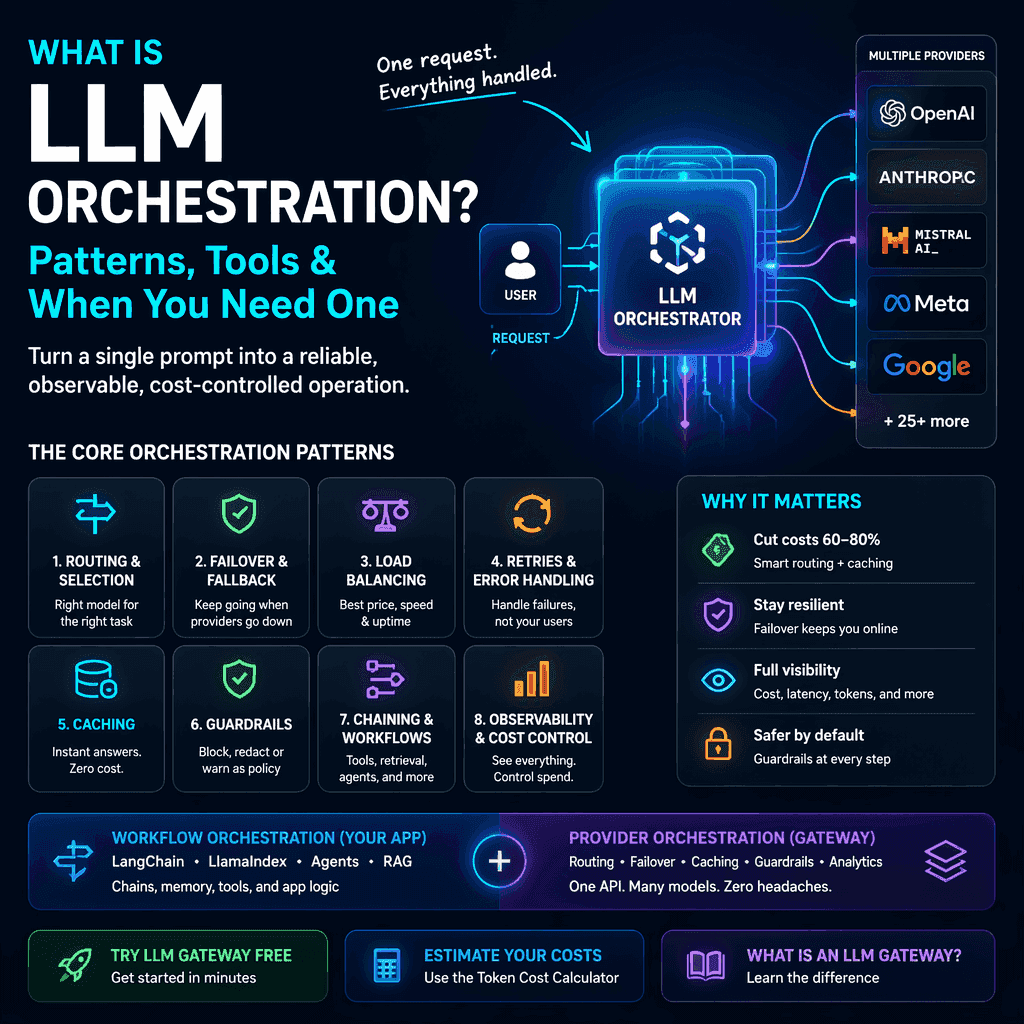
The first version of an AI feature is usually one prompt to one model. The production version almost never is. It's a model choice that depends on the task, a fallback when the provider is down, a retry when the JSON comes back malformed, a cache for repeated questions, and a budget guardrail so a runaway loop doesn't cost a fortune. The discipline of coordinating all of that into one reliable flow is LLM orchestration — and the layer that does it is an LLM orchestrator.
This guide explains what LLM orchestration actually means, the patterns it covers, the tools that handle it, and how to tell when you need a dedicated orchestrator versus a single API call.
What LLM Orchestration Means
LLM orchestration is the coordination of models, providers, and steps so that a single user request becomes a dependable, observable, cost-controlled operation.
It sits between your application and the model providers, and it answers questions a raw API call can't:
- Which model should handle this request?
- Which provider should serve it right now, given price and uptime?
- What happens when that provider errors, times out, or rate-limits?
- Has this exact request been answered before (can we cache it)?
- Is this request safe to send, and is the response safe to return?
- How much did it cost, how long did it take, and where are the logs?
A single model call does none of this. Orchestration is everything around the call that makes it production-grade.
Orchestration vs. a Gateway
People use these terms loosely, so it's worth being precise. An LLM gateway is the infrastructure — a single OpenAI-compatible endpoint that routes to many providers. Orchestration is the set of behaviors that endpoint coordinates: routing logic, failover, retries, caching, guardrails, and observability.
In practice the gateway is where infrastructure-level orchestration lives. Higher up, application frameworks (LangChain, LlamaIndex, agent loops) handle workflow orchestration — chaining steps, calling tools, and managing memory. The two layers complement each other.
The Core Orchestration Patterns
Whatever tool you use, orchestration comes down to a handful of patterns.
1. Model Routing and Selection
Not every request needs your most expensive model. Routing sends classification and extraction to small, cheap models and reserves flagship reasoning models for the requests that need them. Done well, a tiered setup cuts spend 60–80% with no user-visible quality drop. See how to choose the right LLM for the framework.
2. Fallback and Failover
Providers go down. A good orchestrator detects the failure and transparently retries on a healthy provider for the same model — so a single provider outage doesn't become your outage. We wrote about how we handle failover at scale.
3. Load Balancing Across Providers
The same open model (DeepSeek, Llama, Qwen) is sold by multiple providers at different prices and speeds. Balancing traffic across them — weighted by uptime, throughput, price, and latency — is one of the highest-leverage moves available. See how we cut costs 60% with request routing.
4. Retries and Error Handling
Timeouts, 5xxs, and malformed structured output all happen. Orchestration handles bounded retries (and schema re-validation) so transient failures don't bubble up to the user — while capping the blast radius so retries don't multiply your bill.
5. Caching
Many workloads repeat: FAQ bots, classification, batch jobs, dev/test traffic. A cache hit costs nothing and returns instantly. Orchestrators that cache responses (with sensible TTLs) routinely see 30–90% hit rates on suitable workloads. See prompt caching explained.
6. Guardrails
Before a request goes out and before a response comes back, an orchestrator can screen for prompt injection, PII, jailbreaks, and leaked secrets — blocking, redacting, or warning per policy. See LLM guardrails explained.
7. Chaining and Agentic Workflows
At the application layer, orchestration means sequencing steps: retrieve context, call a model, parse the output, call a tool, feed the result back. Agent loops are orchestration too — each tool call is another round-trip the orchestrator coordinates and observes.
8. Observability and Cost Control
You can't operate what you can't see. Orchestration captures per-request cost, latency, tokens, provider, and cache status — and enforces budget limits so spend stays bounded.
One API key for every model.
Route to 200+ models with automatic failover, caching, and real-time cost analytics. Free to start — no credit card required.
The Tooling Landscape
Orchestration tools fall into two broad layers:
Application / workflow frameworks — LangChain, LlamaIndex, and similar libraries orchestrate within your process: chains, agents, memory, tool calls, and RAG pipelines. They're excellent at structuring multi-step logic.
Gateway / infrastructure orchestrators — LLM Gateway, and platforms like LiteLLM, OpenRouter, and Portkey, orchestrate across providers: routing, failover, caching, guardrails, and analytics behind one API. They're excellent at making model calls reliable and cheap. (We compare several of these in 7 best AI gateways in 2026.)
Most production stacks use both: a framework for workflow logic, a gateway for the provider-level orchestration underneath it. They're not competitors — they're different floors of the same building.
When Do You Actually Need an Orchestrator?
You probably don't need a dedicated orchestrator when:
- You're prototyping with one model and one provider
- Traffic is low and an occasional failure is acceptable
- Cost is negligible at your current scale
You do need one once any of these become true:
- You use more than one model or provider — and want one API instead of several SDKs
- Downtime matters — you need failover so one provider's outage isn't yours
- Cost is climbing — routing and caching are your two biggest levers
- You need observability — per-request logs, cost, and latency across everything
- Safety is in scope — guardrails for injection, PII, and secrets
- Multiple teams ship AI — and you need shared keys, budgets, and audit logs
The tipping point is usually the second provider or the first production incident — whichever comes first.
How LLM Gateway Handles It
LLM Gateway is an orchestration layer you don't have to build. Behind one OpenAI-compatible endpoint it provides:
- Smart routing — every provider scored on uptime (50%), throughput (20%), price (20%), and latency (10%), with 1% exploration to keep scores honest
- Automatic failover — transparent retries on a healthy provider when one fails
- Caching — a project-level toggle, Redis-backed, TTL from 10 seconds to a year
- Guardrails — prompt injection, PII, jailbreak, and secret detection with block/redact/warn rules
- Observability — per-request cost, latency, tokens, provider, and cache status in one dashboard
- 200+ models across 40+ providers — including image and video generation through the same API
1import OpenAI from "openai";2
3const client = new OpenAI({4  baseURL: "https://api.llmgateway.io/v1",5  apiKey: process.env.LLM_GATEWAY_API_KEY,6});7
8// Routing, failover, caching, and guardrails all happen here.9const res = await client.chat.completions.create({10 model: "gpt-5.4",11 messages: [{ role: "user", content: "Summarize this ticket." }],12});1import OpenAI from "openai";2
3const client = new OpenAI({4 baseURL: "https://api.llmgateway.io/v1",5 apiKey: process.env.LLM_GATEWAY_API_KEY,6});7
8// Routing, failover, caching, and guardrails all happen here.9const res = await client.chat.completions.create({10 model: "gpt-5.4",11 messages: [{ role: "user", content: "Summarize this ticket." }],12});You can run the math on what an orchestrated, multi-provider setup costs with the Token Cost Calculator, and you can self-host the whole platform under AGPLv3 or use the managed tier.
Frequently Asked Questions
What is an LLM orchestrator? An LLM orchestrator is the layer that coordinates model calls — choosing the model and provider, handling retries and failover, caching, applying guardrails, and capturing cost and latency — so a single request becomes a reliable production operation.
Is an LLM orchestrator the same as an LLM gateway? Closely related. A gateway is the single endpoint/infrastructure that fronts many providers; orchestration is the set of behaviors (routing, failover, caching, guardrails) it coordinates. In practice a gateway is where infrastructure-level orchestration runs.
Do I need LangChain if I have an LLM gateway? They solve different problems. LangChain orchestrates workflow logic inside your app (chains, agents, memory); a gateway orchestrates provider concerns (routing, failover, caching). Many teams use both.
How does orchestration reduce LLM costs? Mainly through routing (send each task to the cheapest model that meets quality) and caching (repeated requests cost nothing). Together these are the two highest-leverage cost levers in production.
TL;DR
- LLM orchestration coordinates models, providers, and steps into one reliable, observable, cost-controlled flow.
- The core patterns: routing, failover, load balancing, retries, caching, guardrails, chaining, and observability.
- Application frameworks orchestrate workflow; gateways orchestrate providers — most stacks use both.
- You need an orchestrator once you add a second provider, hit your first incident, or watch costs climb.
Try LLM Gateway free | What is an LLM gateway? | Estimate your costs
One API key for every model.
Route to 200+ models with automatic failover, caching, and real-time cost analytics. Free to start — no credit card required.